
Bone Grafting Procedure in Beverly Hills, CA
Medically reviewed by Dr. Jonathan Peri, DDS, MD
Rebuilding the bone that holds teeth in
Bone in the jaw only stays where it is being used. Take a tooth out and the bone that surrounded the root begins to shrink within weeks. Most of the width goes in the first year. Gum disease destroys it too, from the top down.
A bone graft rebuilds that volume. Graft material is placed where bone is missing, and over several months your own body replaces it with living bone. It is not a filler that stays put; it is a scaffold your body grows into.
Most often it is done so that an implant has something solid to sit in.
- Usually takes45 to 90 minutes
- NumbingLocal anesthetic, sedation available
- Healing before implants4 to 9 months
- Best timeSame visit as the extraction
You may need a graft if
- You want an implant where a tooth has been missing for a long time
- A tooth is being removed and you want to keep the option of an implant open
- Gum disease has destroyed bone around teeth you still have
- The sinus has dropped into the space above your upper back teeth
- Your denture no longer fits because the ridge underneath has shrunk
The cheapest graft is the one done at the moment the tooth comes out. Preserving bone is far simpler than rebuilding it later.
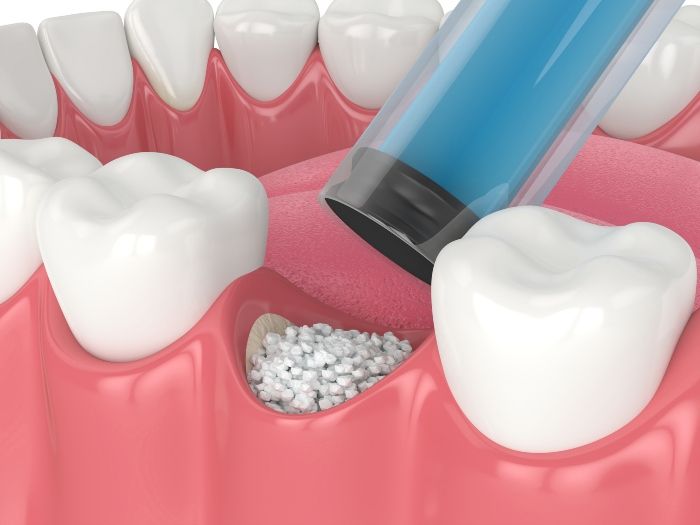
The kinds of graft, and how it is done
- Socket preservation. Graft material placed straight into the socket at the time of an extraction. Quick, and it prevents most of the collapse rather than correcting it.
- Ridge augmentation. Rebuilding width or height where bone has already been lost, usually with a membrane over the top to hold the shape.
- Sinus lift. In the upper back jaw, the sinus floor is gently raised and bone placed underneath so an implant has vertical support.
- Regenerative grafting around teeth. Used in periodontal defects to regain some attachment around a tooth worth saving.
- A 3D scanCBCT imaging shows exactly how much bone there is, in three dimensions, and where the nerve and sinus sit. Grafting decisions are made on this, not on a flat X-ray.
- The procedureUnder local anesthetic, the site is opened, cleaned of any infected tissue, and the graft material packed into the defect. A membrane is often placed over it to stop gum tissue growing into the space before bone can.
- ClosingStitches, sometimes non-dissolving ones removed a week or two later.
- HealingFour to nine months depending on the size. During this time your body remodels the graft into your own bone.
- Re-scan, then the implantWe confirm on a new scan that there is enough bone before placing anything.

Recovery
- Swelling peaks around day two or three, then eases. Cold on the outside for the first day, then warmth.
- Do not lift the lip to look. Pulling on the site is one of the more common ways stitches are lost.
- Soft food and chew elsewhere. Nothing hard, crunchy or seeded near the site.
- After a sinus lift, do not blow your nose, and sneeze with your mouth open, for two weeks. Pressure is the enemy.
- No smoking. It is the strongest predictor of a graft failing, and there is no way around that.
- Finish the antibiotics if they were prescribed, and use the rinse as directed.
Where does the bone come from?
Most often processed donor or bovine material, which is thoroughly sterilized and acts as a scaffold. Your own bone can be used, taken from elsewhere in your jaw. Synthetic options exist too. We will tell you which we plan to use and why.
Is donor material safe?
It is processed to remove all cellular content and has decades of clinical use behind it. If you would prefer to avoid it, say so. There are alternatives and it is a reasonable thing to ask about.
Does it hurt?
The procedure is done fully numb. Afterwards expect soreness and swelling for several days, managed with ordinary painkillers.
How long before I can have the implant?
Four to nine months, depending on the graft size. Small socket grafts are at the shorter end, sinus lifts and large ridge rebuilds at the longer end.
Can grafts fail?
Occasionally. Smoking, infection and uncontrolled diabetes are the main reasons. A failed graft is usually re-done rather than abandoned.
Can I avoid a graft altogether?
Sometimes, shorter or angled implants, or zygomatic implants in the upper jaw, can work around missing bone. The scan tells us whether that applies to you.
Find out how much bone you actually have
- (310) 860-6969Someone here answers.
- Request a visitWe will call to confirm.
- Pick a time onlineChoose your own slot.
The kinds of graft, and where they come from
They all do the same job: provide a scaffold that your own bone grows into and eventually replaces.
- Autograft. Your own bone, usually taken from nearby in the jaw. Biologically the most capable, at the cost of a second surgical site.
- Allograft. Processed human donor bone from a tissue bank, rigorously screened and sterilized. The most commonly used, with a long safety record and no second site.
- Xenograft. Processed bovine mineral. It resorbs slowly, which makes it good at holding shape and volume over time.
- Synthetic. Laboratory-made mineral, with no donor material involved at all.
If donor material raises a religious or personal concern for you, say so. Synthetic options exist, and this is a normal conversation rather than an awkward one.
Healing, and the signs of a problem
Grafts take time. Expect three to six months before an implant can be placed, and longer for larger sites. There is no shortcut, the graft has to be replaced by living bone.
Normal in the first week: swelling peaking around day two or three, bruising, and the occasional graft granule working loose into your mouth. That last one alarms people and is usually of no consequence.
Call us for pain that increases after day three, swelling that worsens rather than settles, pus or a persistent bad taste, fever, or a membrane becoming exposed through the gum.
What most affects success is within your control. Do not smoke. It is the strongest single risk factor for graft failure. Keep the area clean exactly as instructed, avoid pressure from a denture over the site, and finish any antibiotics prescribed.