Expert Laser Periodontal Treatment in Beverly Hills, CA
Medically reviewed by Dr. Kayla Lebeau, DDS
Treating gum disease with a laser instead of a scalpel
When gum disease has formed deep pockets around the teeth, the bacteria living in them cannot be reached by brushing, and often not by cleaning alone. The traditional answer is gum surgery: the tissue is opened with a scalpel, cleaned underneath, and stitched back.
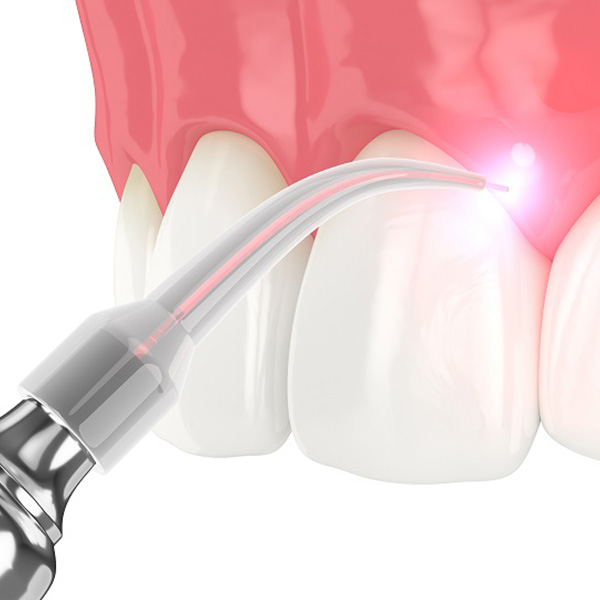
Laser treatment reaches the same pockets through the existing opening. A very fine fiber removes the diseased lining of the pocket and the bacteria in it, while leaving the healthy tissue. No incision, no stitches, and considerably less of the gum recession that follows conventional surgery.
- Usually takes2 sessions, about 2 hours each
- NumbingLocal anesthetic
- StitchesNone
- Back to workUsually the next day
This may suit you if
- You have pockets that have not responded to scaling and root planing
- You have been recommended gum surgery and want a less invasive option
- Your gums bleed, feel tender, or have started to recede
- Teeth have become slightly loose or have started to drift apart
- You take a blood thinner, which makes conventional gum surgery more complicated
It is treatment for the disease, not a cure for the cause. Laser or scalpel, gum disease returns if the daily cleaning and the maintenance visits do not change.
What the sessions involve
- Measuring firstWe chart the depth of every pocket around every tooth and take X-rays of the bone level. Those numbers are the baseline. They are how we prove afterwards whether it worked.
- NumbingLocal anesthetic. The procedure is comfortable, and sedation is available if the idea of it bothers you.
- The laser passThe fiber is guided into each pocket to remove diseased tissue lining and reduce the bacteria there. Healthy tissue is left intact, which is the point of using a laser at all.
- Cleaning the rootUltrasonic and hand instruments remove the hardened deposits from the root surface. The laser does not replace this step, a clean root surface is what the gum reattaches to.
- Sealing and settlingThe laser is used again to form a stable clot at the top of the pocket, sealing it while it heals. Most people go back to normal activity the following day.
Afterwards, and what happens next
- Expect tenderness for a few days, not the swelling and bruising that follows conventional flap surgery.
- Soft food for about a week. The clot at the top of each pocket is doing a job and needs leaving alone.
- Some sensitivity to cold is normal for a few weeks as the gums firm up around the roots.
- Do not smoke. It is the single biggest risk factor for gum disease and for treatment failing.
- Keep the maintenance visits. Usually every three months at first, the interval is shorter than routine cleanings for a reason.
Does it hurt?
The treatment is done under local anesthetic, so no. Afterwards most people describe tenderness rather than pain, and manage with ordinary painkillers.
Is it better than conventional gum surgery?
For the right case it achieves comparable pocket reduction with less recession, no stitches and an easier recovery. For very advanced bone loss, conventional surgery or regenerative grafting may still be the better answer. We will tell you which category you are in after charting.
Will my gums grow back?
Treatment stops the destruction and allows the tissue to reattach and firm up. Gum and bone already lost do not regrow on their own, which is exactly why treating it early matters so much.
How will I know it worked?
We re-chart the same pockets afterwards and compare the numbers to your baseline. Reduced depth and no bleeding on probing is the measure, not how the gums feel.
Will my teeth tighten up?
Teeth loosened by inflammation often firm up as it resolves. Those loose because supporting bone is gone will not, and splinting or replacement gets discussed instead.
How many visits?
Commonly two treatment sessions, then a review at around six weeks, then maintenance every three months.
Get your gums charted properly first
- (310) 860-6969Someone here answers.
- Request a visitWe will call to confirm.
- Pick a time onlineChoose your own slot.
Laser versus traditional gum surgery
Conventional periodontal surgery lifts the gum away from the tooth with a scalpel to reach the root surface and the bone, then stitches it back. It works, it is well proven, and the recovery involves swelling, stitches and a week or two of care.
A laser reaches the same diseased tissue through the existing pocket, without a flap being cut. It removes infected lining selectively and seals small blood vessels as it goes, so there is little bleeding and usually no stitches. Most patients are back to normal considerably faster.
Where honesty is due: laser treatment is not superior in every case. Advanced disease with deep bony defects, or gum recession needing a graft, is still better handled surgically, sometimes with both approaches combined. And no laser removes the need for scaling and root planing or for maintenance visits afterward.
We will tell you which category your case falls into after measuring the pockets, not before.