
All-On-4 in Beverly Hills CA
Medically reviewed by Dr. Jonathan Peri, DDS, MD
A fixed set of teeth on four implants
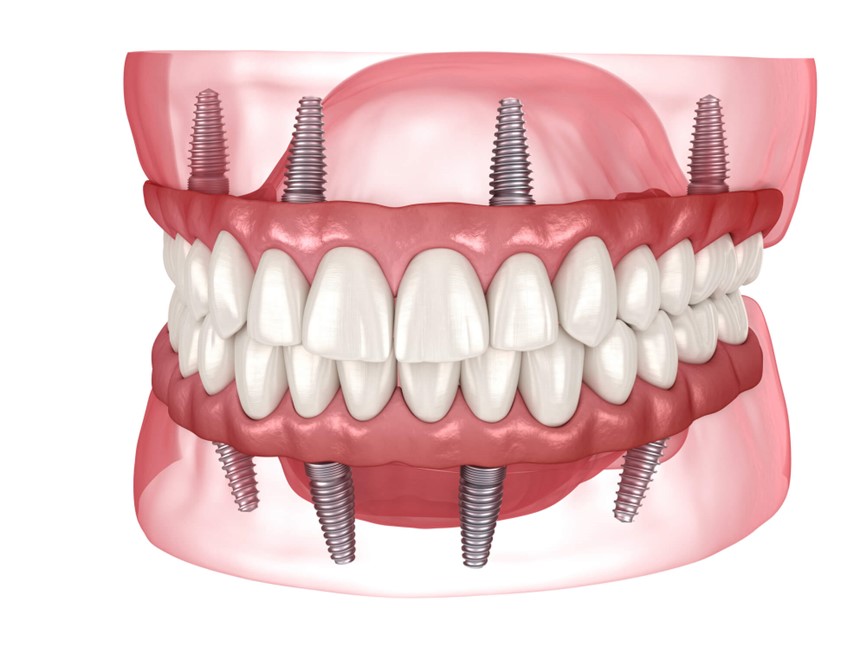
All-on-4 replaces a full arch of teeth with a bridge anchored to four implants. It does not come out. You clean it in your mouth like teeth, not in a glass at night.
The idea behind the four is angulation. The two at the back are placed at an angle so they engage the denser bone at the front of the jaw, which is usually still there even when the back has resorbed. That is what often makes it possible to avoid bone grafting and months of extra healing.
- Implants per archFour, sometimes more
- Teeth the same dayUsually, a fixed temporary bridge
- Final bridgeAfter 3 to 6 months of healing
- Comes out at nightNo
Worth considering if
- You are facing the loss of all the teeth in one jaw
- Your lower denture moves and you have given up on it
- You have been told you do not have enough bone for conventional implants
- You want fixed teeth rather than something removable
- You would rather have one planned surgery than years of individual repairs
It is a significant procedure and a significant cost. It is not the answer for everyone, and we will say so if individual implants or a well-made denture would serve you better.
How the treatment runs
- Planning with a 3D scanA CBCT scan maps the bone volume and the position of the nerve and sinus. The implant positions are planned on that scan before the day, not judged in the moment.
- Surgery dayAny remaining teeth in the arch are removed, the four implants are placed, and a fixed temporary bridge is attached. You go home with teeth. This is done under local anesthetic with sedation if you want it.
- HealingThree to six months while the bone fuses to the implants. You wear the temporary bridge throughout and eat a softer diet at first, which protects that fusion.
- The final bridgeOnce the implants are solid, a definitive bridge is made in zirconia or acrylic on a titanium frame, matched to your face rather than to a catalog.
- Ongoing careReviews, professional cleaning around the implants, and a check of the screw fittings. This is a maintained restoration, not a fit-and-forget one.

The parts people are not usually told
- You still have to clean under it. A fixed bridge sits slightly above the gum, and that space needs a water flosser and superfloss daily. Neglect it and you get peri-implantitis, which is the implant equivalent of gum disease.
- Smoking materially raises the failure rate. We will discuss it honestly rather than pretend it makes no difference.
- Uncontrolled diabetes and some medications affect healing and bone. We need your full medical history at the planning stage, not on the day.
- The temporary is temporary. Treat it gently and stay off hard food, or you will be back to have it repaired.
Does it hurt?
The surgery is done fully numb, with sedation available. Afterwards expect swelling and soreness for several days, managed with prescribed painkillers. Most people describe it as far less bad than they feared.
Do I really leave with teeth the same day?
In most cases, yes, a fixed temporary bridge attached to the implants. Occasionally the bone does not give enough initial stability and we wait, which is a judgment made for the sake of the result.
Why four and not eight?
Because four placed well, with the back two angled into solid bone, will support a full arch. More implants are not automatically better; the right number is what your bone can support.
How long will it last?
Implants themselves commonly last decades. The bridge on top is the wearing part and may need refurbishing or replacing after ten to fifteen years, sooner in acrylic than zirconia.
Will it feel like my own teeth?
Closer than anything removable. It does not move, you can bite into things again, and the palate is left uncovered so you taste food properly.
What if an implant fails?
It is uncommon, and it is not the end of the plan. A failed implant is usually removed, the site healed, and another placed, the design tolerates it.
Start with a scan and an honest assessment
- (310) 860-6969Someone here answers.
- Request a visitWe will call to confirm.
- Pick a time onlineChoose your own slot.
What All-on-4 is, and what it is not
It is a fixed full arch of teeth carried by four implants, two placed straight at the front and two angled at the back. Angling them lets us reach denser bone and often avoids the bone graft or sinus lift that a conventional plan would need, which is the real reason the technique exists.
You leave the surgery day with fixed temporary teeth. That is genuine, and it is also where the marketing overstates things: those are temporary. The final teeth are made months later, once the implants have integrated and the gum has settled into its long-term shape.
Honest limitations. The final bridge is not cleaned like natural teeth. You clean underneath it daily with special brushes or a water flosser, and skipping that is the main cause of late problems. It is removed by us periodically for inspection. And if one implant fails, more of the structure depends on it than in a plan with six or eight.
Where the upper back bone is very deficient, zygomatic implants may be the alternative worth discussing.