
Invisalign® Services in Beverly Hills, CA
Medically reviewed by Dr. Kayla Lebeau, DDS
Straightening without the metal
Invisalign moves your own teeth with a series of clear, removable aligners. You wear each set for a week or two, and each one shifts the teeth slightly further than the last.
We are a Platinum Invisalign Provider, which reflects the number of cases treated here. In practice that means we have seen where it works well, and where fixed braces would genuinely do a better job, which we will tell you.
- Usually takes6 to 18 months
- Wear time20 to 22 hours a day
- VisitsEvery 6 to 8 weeks
- RemovableOut for eating and brushing
Invisalign tends to suit you if
- Your teeth are crowded, gapped or have drifted since childhood braces
- You want straighter teeth without metal showing at work
- You would rather move your own teeth than cover them with veneers
- You can commit to wearing them most of the day. This is the part that decides the result
- Your gums and teeth are healthy, or can be made healthy first
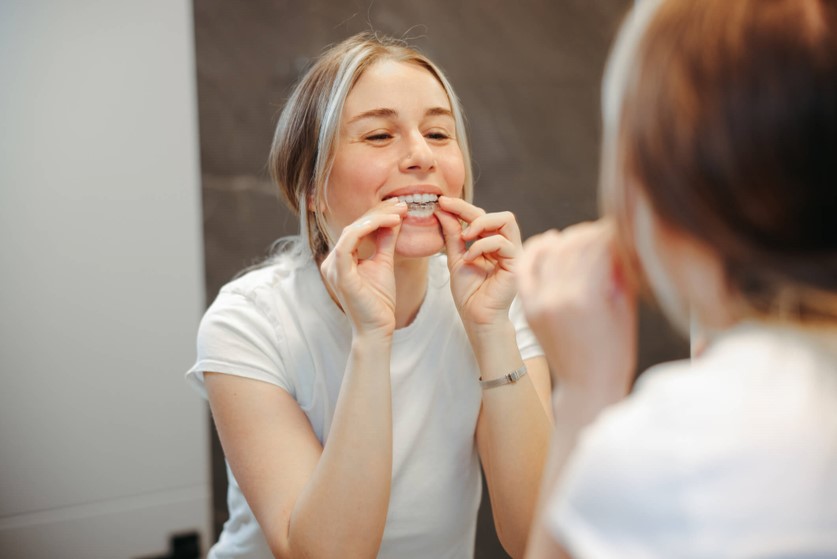
What the process actually looks like
- Digital scanNo impression trays. We scan your teeth and can show you a simulation of the projected result before you commit to anything.
- The planWe map every movement, how many aligners it will take and roughly how long. You see the endpoint first.
- Your alignersYou get several sets at a time, changing them on schedule at home. Small tooth-colored attachments are sometimes bonded on to give the aligners something to grip.
- Check-insEvery six to eight weeks, briefly, to confirm the teeth are tracking to plan. If something is lagging we adjust rather than push on.
- RefinementMost cases finish with a short extra series to settle the detail. This is normal and planned for, not a sign anything went wrong.
- RetainersTeeth drift back if nothing holds them. Retainers are not optional. They are what protects the result you paid for.
Invisalign, braces, or veneers?
These get compared as if they do the same job. They do not.
- Invisalign moves your own teeth. Nothing is removed, nothing is covered. Best for mild to moderate crowding, spacing and relapse.
- Fixed braces still handle severe rotations and large bite corrections better. If that is your case we will say so rather than stretch Invisalign to fit.
- Veneers change color and shape as well as apparent alignment, but they involve removing enamel permanently. If alignment is the only issue, moving the teeth is the more conservative answer.
Cost and insurance
Price depends on how far the teeth have to move, a minor correction and a full-arch case are not comparable. You get the figure in writing at the consultation, and many plans include an orthodontic benefit that applies to Invisalign. Financing is available.
Does it hurt?
There is pressure and tenderness for a day or two with each new set. That is the tooth moving. It settles quickly and most people take nothing for it.
Will it affect my speech?
There may be a slight lisp for a few days while your tongue adjusts. It goes.
Can I take them out for an evening?
Occasionally, yes. That is the advantage. But the aligners only work while they are in. Consistently under 20 hours a day and the teeth stop tracking to plan and treatment takes longer.
Can I eat with them in?
No. Take them out to eat and to drink anything other than water, then brush before putting them back.
What happens when I finish?
Retainers. Teeth have a memory and will drift back without them.
See what your teeth would look like straightened
- (310) 860-6969Someone here answers.
- Request a visitWe will call to confirm.
- Pick a time onlineChoose your own slot.
The treatment process, start to finish
Consultation and records. Photographs, X-rays and a digital scan. No impression putty. We check gum health and decay first, because teeth are not moved in an unhealthy mouth.
The plan. Your scan is used to model the movement stage by stage, and you see a simulation of the projected result before agreeing to anything. Total number of aligners and estimated duration come from this.
Fitting. Attachments are bonded where needed, and any tight contacts are gently created or reduced. You get several sets of aligners and instructions.
Progress visits every six to ten weeks. Short appointments to check the teeth are tracking the plan.
Refinement. Most cases need a short additional series at the end to finish details. This is normal, not a failure, and it should be included in your fee. Ask.
Retainers, and then wearing them indefinitely.
Storage and the mistakes that cost money
- Always use the case. Aligners wrapped in a napkin get cleared away at restaurants. This is the single most common reason for a replacement set and it delays your treatment.
- Keep the previous set until the next one is seated properly. If one is lost, going back a stage is far better than skipping forward.
- Never hot water, and never leave them in a car. Heat warps them and the fit is finished.
- Keep them away from pets. Dogs find them, reliably.
- Take them out to eat or drink anything but water. Heat cracks them, coffee stains them, and sugar trapped underneath causes cavities quickly.
If you lose or break a set, call us the same day rather than waiting for the next appointment. There is almost always a straightforward fix, and delay is what turns it into a problem.